



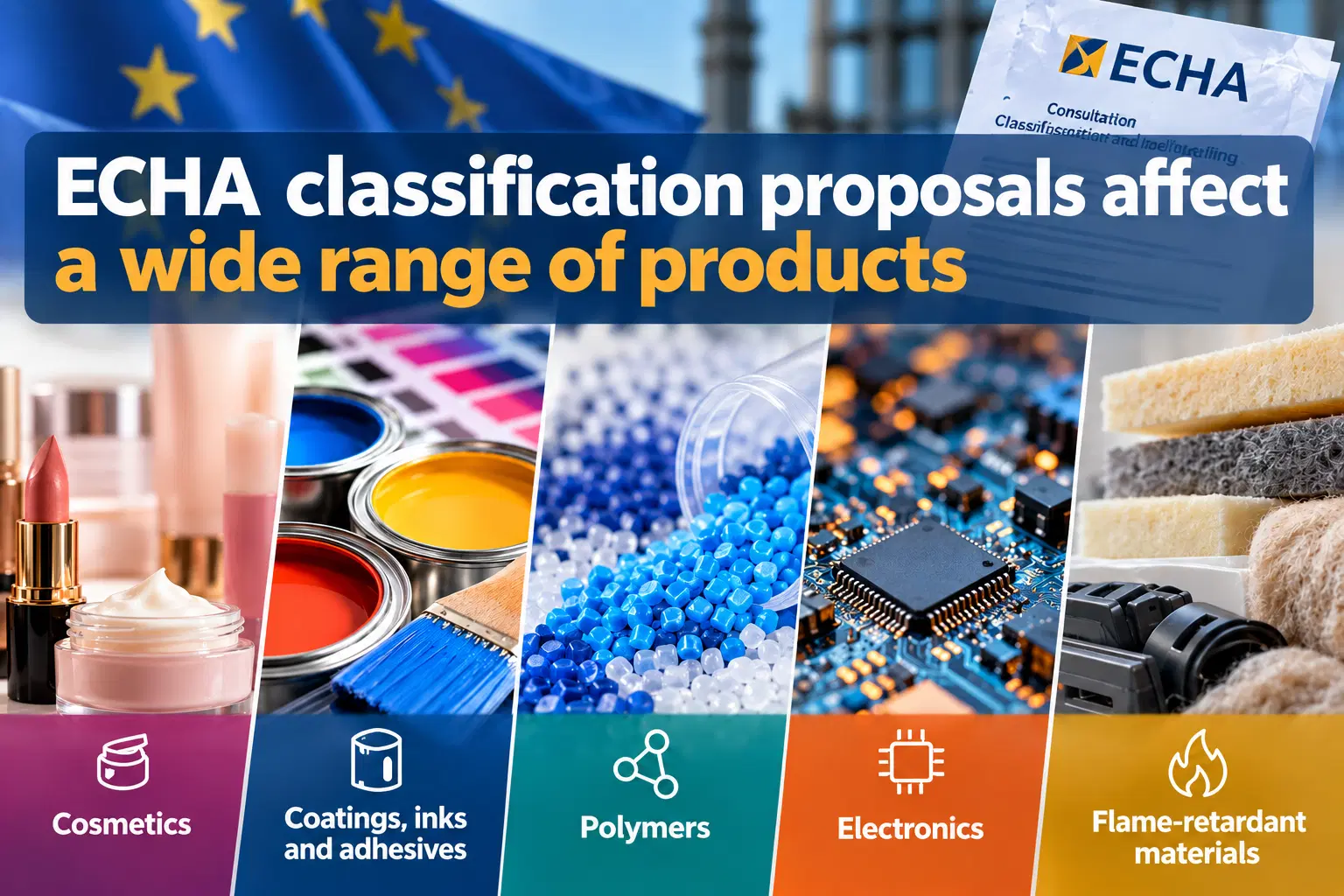
Proposed reproductive toxicity, carcinogenicity, and sensitization classifications could lead to product reformulation, new labeling, safety data sheet requirements, and tighter workplace controls. Companies have until 20 November 2026 to comment.
The European Chemicals Agency (ECHA) is seeking comments on proposed harmonized classifications for chemicals used across cosmetics, inks, coatings, adhesives, polymers, electronics, and flame-retardant materials.
The consultations cover three alkyl 4-(dimethylamino)benzoates and nine phthalic anhydrides. Proposed hazards include reproductive toxicity, suspected carcinogenicity, and respiratory and skin sensitization. The classifications are not final, but companies may need to start identifying affected products and uses while they can still contribute evidence to ECHA's assessment.
Cosmetics, electronics, inks, and coatings face reproductive toxicity proposal
Ethyl 4-(dimethylamino)benzoate (CAS 10287-53-3), 2-ethylhexyl 4-(dimethylamino)benzoate (CAS 21245-02-3) and 3-methylbutyl 4-(dimethylamino)benzoate (CAS 21245-01-2) are proposed for Reproductive Toxicity Category 1B (Repr. 1B), H360F — May damage fertility.
The proposal reflects concerns that the three chemicals may impair fertility. They were assessed together because of their structural and toxicological similarities, allowing evidence to be read across the group.
If adopted, Repr. 1B could have consequences well beyond a new label. Under the EU Cosmetics Regulation, CMR Category 1B substances are generally prohibited in cosmetic products unless strict conditions for an exception are met. This could directly affect cosmetics containing 2-ethylhexyl 4-(dimethylamino)benzoate, which has reported cosmetics and personal-care uses. The dossier also cites a current lip-balm use for 3-methylbutyl 4-(dimethylamino)benzoate, although it does not establish that this use occurs in the EU.
For other products, a different regulatory pathway could become important. Repr. 1B would make all three substances eligible for identification as substances of very high concern (SVHCs) under the Registration, Evaluation, Authorisation and Restriction of Chemicals (REACH) Regulation. SVHC identification and Candidate List inclusion would require a separate regulatory process.
If subsequently placed on the Candidate List, concentrations above 0.1% by weight in articles could trigger requirements to communicate information through the supply chain and submit information to the SCIP database. Producers and importers may also have to notify ECHA where applicable volume and concentration thresholds are met, subject to exemptions. Candidate List substances may subsequently be considered for the REACH Authorisation List; that is also a separate regulatory step.
These potential consequences could extend to electronics and other manufactured products. 2-ethylhexyl 4-(dimethylamino)benzoate is used in printed circuit board manufacturing, as well as inks, coatings, adhesives, photochemicals, and polymer preparations. Its use in electronics manufacturing does not establish that it remains in the finished circuit board, so future article obligations would depend on whether it is present and at what concentration.
Ethyl 4-(dimethylamino)benzoate is used in coatings and inks and as a monomer in an imported polymer. ECHA also identifies service-life uses associated with vehicles and metal, paper, wood, and plastic articles.
Polymers, coatings, and industrial chemicals face respiratory sensitization proposals
Eight phthalic anhydrides are proposed for Respiratory Sensitisation Category 1 (Resp. Sens. 1), H334 — May cause allergy or asthma symptoms or breathing difficulties if inhaled:
4,4'-biphthalic dianhydride (CAS 2420-87-3);
benzophenone-3,3':4,4'-tetracarboxylic dianhydride (CAS 2421-28-5);
4,4'-oxydiphthalic anhydride (CAS 1823-59-2); 5,5'-sulfonyldi(2-benzofuran-1,3-dione) (CAS 2540-99-0);
tetrabromophthalic anhydride (CAS 632-79-1);
ethylene bis[1,3-dihydro-1,3-dioxo-iso-benzofuran-5-carboxylate] (CAS 1732-96-3);
4-chloroformylphthalic anhydride (CAS 1204-28-0); and 1,2,3,6-tetrahydromethyl-3,6-methanophthalic anhydride and its individual isomers and combinations (CAS 25134-21-8 and others).
Direct respiratory sensitization data are limited for several of the chemicals. The proposals therefore rely on read-across from structurally similar phthalic anhydrides already classified as respiratory sensitizers. Human evidence for the source substances includes asthma, rhinitis, and immunological responses, while the cyclic anhydride group shared by the chemicals is identified as a structural alert for respiratory sensitization.
If adopted, companies would need to assess whether the new H334 classification changes the classification of mixtures containing these substances. Where it does, suppliers would need to update product labels and safety data sheets and communicate the respiratory sensitization hazard to customers. Companies using the chemicals would also need to reassess inhalation exposure and workplace controls, particularly during formulation, packaging, and other processes where airborne exposure can occur.
That is relevant because the dossiers specifically identify potential inhalation exposure during formulation and packaging, particularly where manual or open processes are used.
Uses differ by chemical. 4,4'-biphthalic dianhydride, benzophenone-3,3':4,4'-tetracarboxylic dianhydride, 4,4'-oxydiphthalic anhydride, and 5,5'-sulfonyldi(2-benzofuran-1,3-dione) have reported industrial uses across coatings and paints, polymer preparations, or photochemicals, depending on the substance.
Tetrabromophthalic anhydride is also reported as a flame retardant in unsaturated polyester resins and molding products. ECHA reports no identified use information for 4-chloroformylphthalic anhydride.
Some substances face additional classifications. 4-chloroformylphthalic anhydride is also proposed for skin corrosion, serious eye damage, and respiratory irritation, while 1,2,3,6-tetrahydromethyl-3,6-methanophthalic anhydride faces proposed classifications including acute inhalation toxicity, serious eye damage, and skin irritation.
Flame-retardant chemicals face cancer and sensitization classifications
Chlorendic anhydride (CAS 115-27-5) already has harmonized classifications for skin and eye irritation and specific target organ toxicity following single exposure. ECHA is proposing to add Carcinogenicity Category 2 (Carc. 2), H351 — Suspected of causing cancer; Respiratory Sensitisation Category 1, H334; and Skin Sensitisation Category 1, H317.
The cancer proposal relies on studies of chlorendic acid (CAS 115-28-6), a hydrolysis product and impurity of chlorendic anhydride, because carcinogenicity studies on chlorendic anhydride itself were unavailable. The skin sensitization proposal is supported by human evidence of contact urticaria and read-across from related phthalic anhydrides.
Carc. 2 does not create the same CMR/SVHC pathway as a Category 1A or 1B classification. But the proposed classifications could still require concrete changes for suppliers. Companies would need to determine whether mixtures containing chlorendic anhydride require reclassification and, where applicable, revise labels and safety data sheets to reflect the new cancer and sensitization hazards. Companies using the substance would also need to reassess worker exposure and controls for skin contact and inhalation.
Those implications are relevant to several industrial applications. Chlorendic anhydride is used as an industrial intermediate and in polymer preparations and compounds. The dossier also reports its use as a flame-retardant monomer in polyester resins and plasticizers, coatings, polyurethane foams, and wool textiles.
Why companies should assess their supply chains now
The proposals do not require companies to start reformulating products now. But businesses should begin identifying whether the substances are present in their products and supply chains.
Doing so before the consultation closes can establish which products could ultimately be affected, whether the substances remain in finished articles, their concentrations, and where worker exposure may occur. It can also help companies determine whether they or their suppliers hold toxicological, use, or exposure information relevant to ECHA's assessment.
For companies using the three proposed Repr. 1B substances, that means identifying potentially affected cosmetics and determining whether the chemicals remain in electronics, vehicles, polymers, or other finished articles. Companies handling the proposed respiratory sensitisers should identify formulations and manufacturing processes where inhalation exposure could occur and consider how a final H334 classification would affect mixture classification, labels, safety data sheets, and workplace controls.
Companies with relevant toxicological use or exposure information can submit comments to ECHA until 20 November 2026.